
Who makes sure the work gets done?
In Verified, Not Trusted: Expense Analysis, Part One, we compared two prompts’ instructions and examined one recorded response. The more precise prompt specified parsing, cleanup, calculation with code, and evidence before conclusions. The model still controlled whether those steps happened and how their results were used. Here, in the second of four articles, we’ll follow a Python implementation that controls the sequence, checks model contributions, and builds the report from checked results.
Would we be comfortable relying on the prompt discussed in the previous article?
Look at where control resides. Coordinating the steps, their inputs, and what happens next is orchestration. The controller runs the control loop: choosing an action, examining its result, and deciding what to do next. In the prompt-based workflow, the model is the controller. Asking it to use Python has not transferred control of the workflow to Python.
Calling Python leaves several things to verify
First, execution needs evidence. Showing Python in an answer does not establish that it ran. We need the execution record and the inputs and outputs associated with the call.
Second, implementation needs inspection. This prompt asks the model to generate Python during the run. Part One’s recorded code assigns months by line position despite the request to parse dates. Successful execution does not make it the requested implementation. Supplying our own reviewed and tested code, with instructions to use it without generating a replacement, would reduce that risk.
Third, use of returned results needs verification. Even when a tested function returns the correct value, the model still decides what to carry into subsequent calculations and the report.
Correct execution does not guarantee a correct report
Suppose the tested function returns $398.69 for August dining. The model now has that answer. What establishes that it uses $398.69 in the report and in the budget comparison? It could write $389.69 or reuse a total calculated before a correction. The function has done its job correctly. The delivered result can still be wrong.
We must check that the intended operation ran with the intended inputs, that its result met the requirements, and that subsequent steps used that result. Verifying the function call alone leaves the rest of that chain unchecked.
This is why I want Verified, not trusted as the starting point. I don’t find “trust but verify” useful here. It grants the answer trust before we have established a reason for doing so. The order I want is Verified, therefore trusted. Until the relevant checks have passed, that answer has not earned our trust. And the trust extends only as far as those checks establish.
The stakes and the person in the loop
The choice depends on the consequences of an error and whether a person verifies each result. A prompt or skill can be reasonable for exploring household expenses while you check the entries and tallies. When organizational expense accounting runs unattended, nobody reviews each run before its result enters business records. I would not put that responsibility in the hands of a model-controlled prompt. When the consequences are serious, “it usually gets it right” is nowhere near good enough.
High stakes can still involve a human reviewer, and low-stakes work can run unattended. Increasing the stakes demands stronger evidence. Removing the reviewer means the application must perform the checks that person would otherwise perform. I want successful completion to depend on those checks. Watching an answer appear is not verification.
Put imperative code in charge of orchestration
For the automated end of that spectrum, I want the application to own the control loop. We write and test the code that calls each required operation, passes its result forward, and determines whether the next step can proceed. A model cannot decide that a required check is unnecessary and still obtain a completed report through that path.
Consider the expense calculation. The application first accounts for the source entries and their treatment. It passes that ledger to the calculation function, checks the totals, and uses the returned values to construct the tables. If reconciliation fails, the application stops that path before presenting findings. The returned amount has a defined route into the report, with no model asked to reproduce the number along the way.
| Responsibility | Model-controlled orchestration | Imperative orchestration |
|---|---|---|
| Required calls and their order | The model interprets the instructions and requests actions | Application code defines the calls and their dependencies |
| Calculation implementation | The model generates code during the run | Maintained, reviewed, and tested code performs the calculation |
| Use of returned values | The model decides how to use the tool response | Code passes returned values into subsequent operations and report construction |
| Acceptance and failure | Instructions ask the model to check and respond | Programmed checks control acceptance, retries, and failure paths |
This is code we must maintain and test. Its value is that we can inspect and test the required sequence, the movement of values, and the failure behavior as an implementation. We can make successful completion depend on those checks.
Models still have useful work to do inside that flow. Interpreting an ambiguous transaction is one example. The application asks for that judgment, checks the response against the evidence it holds, and determines how to proceed. The model’s answer is an input to the controller.
A skill can invoke this maintained workflow. Skills package instructions and capabilities; the application underneath can still control the calculation and report. I discuss that distinction further in Skills versus Controlled Workflows.
The implementation below uses imperative Python as the controller. Its calls and branches form a directed graph, with model calls inside particular steps. It also preserves unresolved entries in the report. An application that acts on that report must define which unresolved conditions prohibit action; a report with missing amounts cannot acquire permission to proceed merely because the arithmetic balances.
Give the model the smallest useful job
Before adding a model call, I want to ask: Can ordinary code do this step?
Adding amounts, grouping transactions by month, comparing a total with a budget, preserving line numbers, and producing a Markdown table all have rules we can implement directly. A model adds no useful judgment to those operations.
Understanding an unfamiliar transaction description is different. A model may help decide which category the description supports. A line containing several dates or amounts may also need contextual interpretation. Even then, we can often narrow the job to choosing among values that code has already found.
The implementation uses Jev, an AI model from TypeSafe that makes bounded decisions from supplied evidence and returns typed answers and probabilities. TypeSafe calls this a System One model: the emphasis is on fast, focused judgments that software can use directly. Its Choice operation selects among supplied options. That suits a question such as “Which of these source amounts is the transaction amount?” See the System One documentation and Choice reference.
An LLM can perform classification too. The architectural decision is to isolate the judgment behind a small contract so that code can inspect the answer. Here, Jev handles choices, and an LLM is available for unresolved extraction and a final, tightly constrained selection of findings. All the controller and processing code shown below is Python.
Notice how small those jobs are. The model does not receive authority to remove transactions, change the category policy, calculate a total, or invent a report finding.
The walkthrough assumes you can read asynchronous Python, dataclasses and typed models. Follow three responsibilities through the code: preserve each source line, check model proposals against that source, and build the report from values Python calculated. The eight numbered steps show where each responsibility is enforced.
The excerpts and eight-line walkthrough correspond to this source revision. The repository may evolve; use that revision to follow the members shown here.
The graph is visible in the controller
The main operation in ManagerExpenseAnalysis shows the order of work. The excerpts below retain the implementation’s members with their outer class indentation removed; imports and surrounding members are omitted. The processor methods provide the details we’ll examine next.
async def analyze_expenses(self, expense_lines: Sequence[str], confirmed_duplicate_line_numbers: tuple[int, ...] = ()) -> ExpenseAnalysisResult:
    ValidatorExpenseLines.validate(expense_lines)
    parsed_expense_lines: tuple[ParsedExpenseLine, ...] = await self._parse_and_extract(expense_lines)
    expense_categorization_slots: tuple[ExpenseCategorization | None, ...] = await self._categorize_lines(parsed_expense_lines)
    expense_transactions: tuple[ExpenseTransaction, ...] = await self._expense_reconciliation_processor.reconcile(
        parsed_expense_lines, expense_categorization_slots, confirmed_duplicate_line_numbers
    )
    expense_calculation_result: ExpenseCalculationResult = await self._calculate(expense_transactions)
    expense_findings: tuple[ExpenseFinding, ExpenseFinding, ExpenseFinding] = await self._expense_findings_llm_processor.findings(
        expense_calculation_result
    )
    return self._build_result(
        parsed_expense_lines, expense_categorization_slots, expense_transactions, expense_calculation_result, expense_findings
    )
Read down the method. Input validation precedes parsing. Categorization finishes before reconciliation. Reconciliation precedes calculation. Findings are selected only after calculation has completed its checks.
There is no model deciding whether reconciliation seems necessary today. The next call is written into the program.
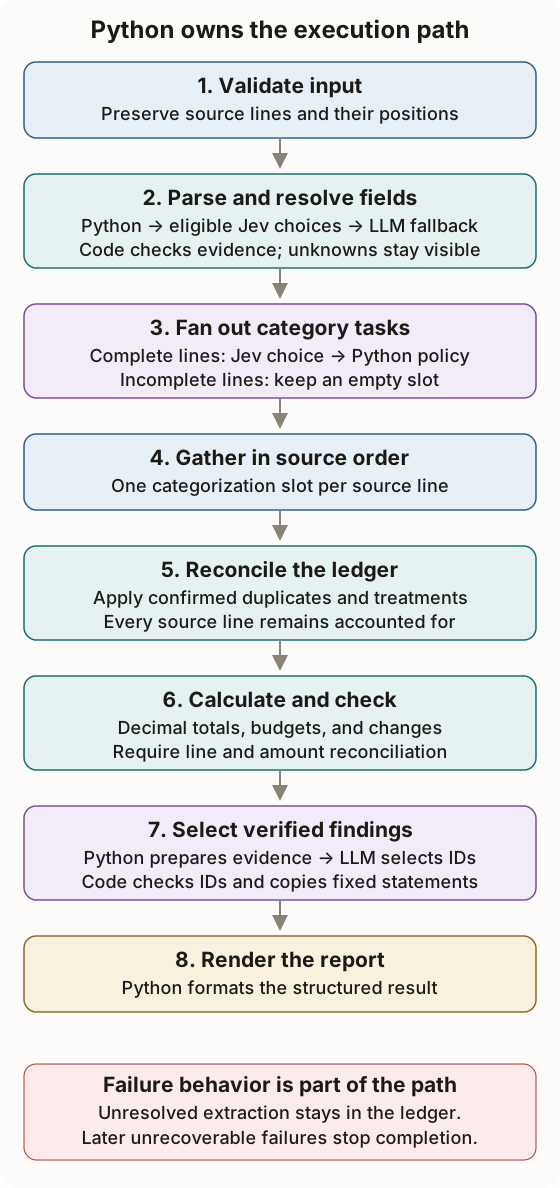
We can describe this as a directed graph without introducing a graph framework. Calls establish dependencies, conditions establish branches, and a task group provides fan-out and fan-in. The extraction and findings processors also contain bounded retry loops. Drawing the main path as a sequence does not remove those branches or retries.
The benefit comes from who controls those transitions. Python does.
Eight lines to follow through the workflow
We’ll use a small, invented log so we can follow every entry. The line numbers below are positions in the input, starting at one; they are not part of the source text.
2026-06-01 | Kroger | $82.18
2026-06-01 | Kroger | $82.18
2026-06-02 | Cafe | charge $7.50; available balance $102.00
2026-06-03 | ATM withdrawal | $40.00
2026-06-04 | Bank transfer | -$15.00
2026-07-01 | Kroger | $50.00
2026-07-02 | Target | $20.00
2026-07-03 | Unknown store | amount missing
For this example, the application calling analyze_expenses supplies its confirmation that line 2 duplicates line 1 before the run starts; the workflow does not pause to ask a person. We’ll use monthly targets of $100 for Dining & Coffee and $100 for Shopping. These are example targets, separate from Part One’s budgets.
To make the path reproducible, the walkthrough fixes the model responses: Jev leaves line 3’s amount unresolved, the LLM identifies the $7.50 charge, and the missing amount on line 8 stays unknown. Later category proposals are stated where they matter. These choices illustrate execution paths; they are not measurements of model accuracy.
1. Parse what code can parse
The first processor searches each line for dates and amounts using explicit parsing rules. A single supported date or amount can be read directly. Multiple candidates create an issue to resolve. A missing field stays missing.
The result preserves the source alongside the extracted values:
@dataclass(frozen=True, slots=True)
class ParsedExpenseLine:
    line_number: int
    source_text: str
    occurred_on: date | None
    description: str | None
    amount: Decimal | None
    issues: tuple[str, ...]
line_number and source_text provide the connection back to the input. None has a specific meaning: the field has not been established. The issues tuple records why further work is needed. The frozen dataclass makes each result a value to pass between steps; later processors create updated values.
Amounts use Decimal. The parser reads the decimal amount from its source text, preserves signed amounts, and applies explicit refund rules. Dates come from the entry itself. Where a year is missing, the processor infers one only when the available dates support that inference; it does not silently substitute today’s year.
Line 1 has one date and one amount, so Python can establish both. Line 3 has two amounts: $7.50 and $102.00. Choosing the first number unconditionally would hide a decision inside a convenient parsing shortcut. This parser records the ambiguity. Line 8 has no amount to extract at all.
The loop makes source coverage explicit:
def _parse_lines(self, expense_lines: Sequence[str], inferred_year: int | None) -> tuple[ParsedExpenseLine, ...]:
    parsed_expense_lines: list[ParsedExpenseLine] = []
    for line_number in range(1, len(expense_lines) + 1):
        source_text: str = expense_lines[line_number - 1]
        issues: list[str] = []
        occurred_on: date | None = self._parse_line_date(source_text, inferred_year, issues)
        amount: Decimal | None = self._parse_line_amount(source_text, issues)
        description: str | None = self._parse_line_description(source_text, issues)
        parsed_expense_lines.append(ParsedExpenseLine(line_number, source_text, occurred_on, description, amount, tuple(issues)))
    return tuple(parsed_expense_lines)
The append runs for every line, including lines the parser cannot complete. There is no filter that discards a result because issues is nonempty. That gives later reconciliation something to account for. A failed parse cannot quietly make an expense disappear.
2. Ask Jev to choose from source evidence
The parsing cascade is also explicit:
async def _parse_and_extract(self, expense_lines: Sequence[str]) -> tuple[ParsedExpenseLine, ...]:
    parsed_expense_lines: tuple[ParsedExpenseLine, ...] = await self._expense_line_parsing_processor.parse(expense_lines)
    inferred_year: int | None = self._expense_line_parsing_processor.infer_year(expense_lines)
    jev_parsed_expense_lines: tuple[ParsedExpenseLine, ...] = await self._expense_line_jev_extraction_processor.extract_uncertain_lines(
        parsed_expense_lines, inferred_year
    )
    return await self._expense_line_extraction_llm_processor.extract_uncertain_lines(jev_parsed_expense_lines, inferred_year)
Calling each processor does not mean calling each model. The Jev processor considers eligible ambiguities, and the LLM processor receives only lines whose issues remain unresolved.
For line 3, Python has already located two amount occurrences. The Jev question offers a finite set:
| Choice key | Meaning |
|---|---|
candidate_0 |
The source occurrence containing $7.50 |
candidate_1 |
The source occurrence containing $102.00 |
none |
None of these is the transaction field |
The question asks which amount affects the account as the transaction, taking the surrounding wording into account. We need the model’s interpretation of “charge” and “available balance.” We already have code that can read the numbers.
Here is the gate that decides whether to accept the selected candidate:
def _accepted_candidate_index(self, choice_decision: ChoiceDecision, candidate_descriptions_by_choice_key: Mapping[str, str]) -> int | None:
    if (
        choice_decision.choice not in candidate_descriptions_by_choice_key
        or choice_decision.probabilities[choice_decision.choice] < self._minimum_choice_probability
    ):
        return None
    if choice_decision.choice == self._NONE_CHOICE:
        return None
    return int(choice_decision.choice.removeprefix(self._CANDIDATE_PREFIX))
There are three checks worth noticing. The choice must belong to the supplied set. The probability associated with that choice must meet the configured minimum. And none remains a valid way to decline selection.
The gate uses probabilities[choice]: the probability assigned to the selected option among the offered candidates. Jev’s separate confidence summarizes how concentrated the whole distribution is. This implementation asks whether that particular choice meets the minimum probability, so it reads the choice’s probability directly. Neither field measures observed accuracy on our expenses.
After selection, Python retrieves the original occurrence, parses it again, rejects an occurrence identified as a balance, and applies the amount’s sign and refund rules. The model supplies an index into evidence that the application already holds.
That probability threshold is a routing rule. It cannot prove that the selected amount is correct. A confidently wrong selection still has to face the source and policy checks, and those checks have limits too. The threshold needs evaluation against representative inputs before we rely on it operationally.
Restrict the possible answer, check the choice, and derive the value from the source. In this walkthrough, Jev leaves line 3 unresolved, so Python passes it to the LLM stage.
3. Use the LLM for what remains unresolved
Line 3 reaches this stage with its amount still unresolved. A Jev choice of none or a selected probability below the minimum leaves that field open. The LLM processor now attempts to extract the missing information from the source.
This fallback also covers other unresolved parsing problems that Jev’s candidate selection cannot solve. A failed Jev extraction request can leave a line for this stage. The LLM is given the unresolved source lines, the known fields, an output schema, and instructions to supply evidence.
For the amount on line 3, the relevant part of the proposed answer is:
{
  "amount": "7.50",
  "amount_evidence": "$7.50",
  "amount_evidence_index": 0
}
This is a fragment of a line response, not the complete response schema. The full response also carries line identity, source text, and the date and description fields. The amount is a decimal string. The zero-based index identifies an occurrence among the line’s amount candidates.
Why bother with an occurrence index? Because the same number can appear twice. “Charge $50.00; balance $50.00” contains identical amount text with two different meanings. Checking that the string occurs somewhere would not establish which occurrence the model used.
The amount-validation method shows where the accepted value comes from:
def _validated_amount(
    self,
    original_parsed_expense_line: ParsedExpenseLine,
    extracted_amount: str | None,
    amount_evidence: str | None,
    amount_evidence_index: int | None,
) -> Decimal | None:
    if original_parsed_expense_line.amount is not None:
        return self._validated_known_amount(original_parsed_expense_line.line_number, original_parsed_expense_line.amount, extracted_amount)
    if extracted_amount is None:
        return None
    amount_validation_evidence: _AmountValidationEvidence = _AmountValidationEvidence(
        original_parsed_expense_line.source_text,
        original_parsed_expense_line.line_number,
        extracted_amount,
        amount_evidence,
        amount_evidence_index,
    )
    amount_evidence_occurrence: AmountEvidenceOccurrence = self._required_amount_occurrence(amount_validation_evidence)
    evidence_amount: Decimal = self._amount_from_occurrence(original_parsed_expense_line.source_text, amount_evidence_occurrence)
    self._require_matching_amount_evidence(original_parsed_expense_line.line_number, extracted_amount, evidence_amount)
    return evidence_amount
If Python already knows the amount, the response cannot change it. Otherwise, the processor requires a supported source occurrence, derives the amount from that occurrence, and checks that the proposed decimal value agrees. It returns evidence_amount, the value reconstructed from the source.
Other checks require the correct source text and line numbers, preserve known dates and amounts, and validate evidence for newly extracted fields. A schema-valid response is only the beginning of acceptance.
The processor allows two semantic attempts in total: the first response and one retry. It retains successful resolutions and retries the remaining problems. Unresolved or failed extraction stays visible with issues; it does not acquire an invented value to keep the report looking complete. In our example, line 8 remains without an amount.
A model cannot recover a purchase amount that the supplied record does not contain. More eloquent instructions do not create the missing evidence.
Verified, not trusted means accepting only what the checks support, including accepting that a field is still unknown.
4. Categorize complete lines concurrently
Once extraction finishes, each complete line can be categorized independently. This is the fan-out portion of the graph. The manager creates a task for each parsed line and limits concurrent categorization work to eight:
async def _run_categorization_tasks(self, parsed_expense_lines: tuple[ParsedExpenseLine, ...]) -> tuple[ExpenseCategorization | None, ...]:
    semaphore: asyncio.Semaphore = asyncio.Semaphore(8)

    async with asyncio.TaskGroup() as task_group:
        tasks: tuple[asyncio.Task[ExpenseCategorization | None], ...] = tuple(
            task_group.create_task(self._categorize_one(parsed_expense_line, semaphore)) for parsed_expense_line in parsed_expense_lines
        )
    return tuple(task.result() for task in tasks)
The per-line method first checks for a date, description, and amount. An incomplete line returns None for its categorization slot. A complete line enters the semaphore and asks the categorization processor to do its work.
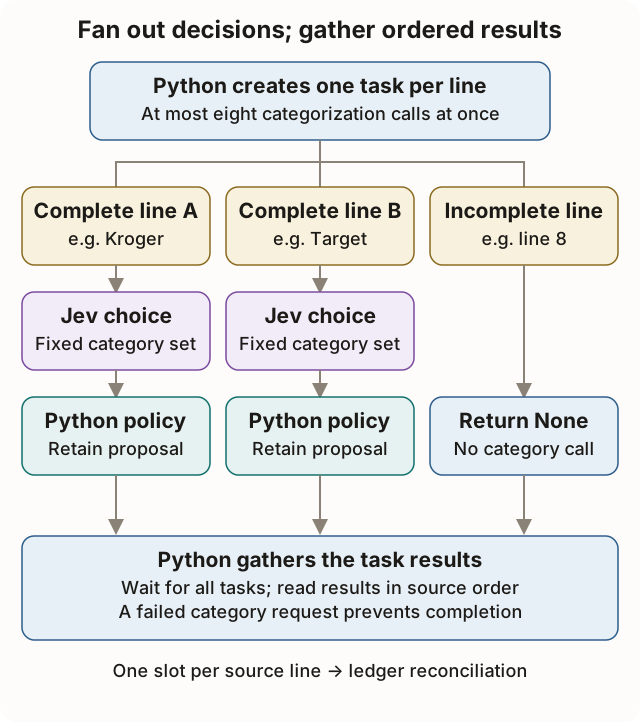
Jev is used again here, for a different question. The options now come from a fixed expense-category catalog. The processor asks for the category supported by the transaction, then applies application policy:
async def categorize(self, source_line_number: int, source_text: str, description: str | None = None) -> ExpenseCategorization:
    decision: ChoiceDecision = await self._gateway.choose(source_text, self._choice_question())
    model_category, probabilities = self._translate_decision(decision)
    category, policy_note = self._apply_category_policy(description, model_category)
    return ExpenseCategorization(
        source_line_number=source_line_number,
        source_text=source_text,
        category=category,
        model_category=model_category,
        policy_note=policy_note,
        confidence=decision.confidence,
        probabilities=probabilities,
    )
Keeping model_category separately from category is useful. We can see both the model’s proposal and the application’s final decision. If a policy changes that decision, policy_note explains it.
For example, suppose Jev proposes Shopping for the merchant-only Target entry. Python assigns Other because the purchased item is unknown. Suppose Jev proposes Other for the ATM withdrawal and bank transfer. Python assigns Uncategorized because neither description establishes a spending purpose. Exact known-merchant rules supply the configured category for merchants such as Kroger.
These rules are repeatable, inspectable decisions. They also remain policies with limits. A merchant name does not prove which items were purchased. Classifying a Kroger charge according to the catalog verifies application of that rule; a receipt would provide stronger evidence about the purchase itself.
This version asks Jev about every complete line before applying the deterministic policy, even when a known-merchant rule will determine the result. It retains the proposal for inspection.
The probability-based LLM fallback in this implementation belongs to date and amount extraction. Categorization uses Jev followed by code policy; it does not currently send low-probability category decisions to an LLM. The same routing idea could be added there, but its accepted outputs and failure policy would need to be defined and tested.
Fan-in preserves the relationship to the source
Tasks may finish in any order. The tuple of tasks is created in input order, and task.result() is read in that same order after the task group completes. Completion order therefore cannot attach a category to the wrong transaction.
Our resulting slots are:
1 groceries
2 groceries
3 dining_coffee
4 uncategorized
5 uncategorized
6 groceries
7 other
8 None
The final slot matters. The source line has not vanished because there was nothing to categorize.
A failed category request has different behavior from an incomplete source line: it propagates through the task group and prevents successful completion. The code does not disguise a failed service call as an ordinary empty categorization.
5. Reconcile every source line
The reconciliation processor receives the parsed lines and their aligned category slots. It checks the lengths and verifies that each nonempty category result names the corresponding line and source text:
@staticmethod
def _validate_alignment(
    parsed_lines: tuple[ParsedExpenseLine, ...],
    categorizations: tuple[ExpenseCategorization | None, ...],
) -> None:
    if len(parsed_lines) != len(categorizations):
        raise ValueError("Each parsed expense line must have a corresponding categorization slot")

    for parsed_line, categorization in zip(parsed_lines, categorizations, strict=True):
        if categorization is not None and (
            categorization.source_line_number != parsed_line.line_number
            or categorization.source_text != parsed_line.source_text
        ):
            raise ValueError(f"Categorization does not match expense source line {parsed_line.line_number}")
Equal counts alone would allow two category results to be swapped. Checking both identity and source text catches that mismatch before amounts are assigned to categories. The processor then creates one ledger transaction per source line.
Each transaction receives one treatment:
| Treatment | Lines | Effect |
|---|---|---|
included_spending |
1, 3, 6, 7 | Include the signed amount in its month and category |
excluded_duplicate |
2 | Retain the entry and its link to line 1; count no second charge |
uncategorized_outflow |
4 | Retain the $40 withdrawal as unresolved outflow |
uncategorized_credit |
5 | Retain the −$15 transfer separately from spending totals |
unparsed |
8 | Retain the source and its missing amount; contribute no invented number |
This is where our confirmed duplicate takes effect. The caller supplies (2,) as confirmed_duplicate_line_numbers. The processor verifies that the indicated entry is an exact adjacent duplicate with matching parsed values. An invalid confirmation raises an error.
Two identical charges can both be real. Code can establish that two recorded lines match; it cannot establish from that fact alone that only one purchase occurred. Requiring an explicit confirmation keeps that decision visible. The confirmation is supplied before execution, so it does not require an interactive question in the middle of a run. With no confirmation, both entries remain countable.
A categorized refund stays in included_spending with its negative amount. The bank transfer on line 5 is different: its purpose is unknown, so subtracting it from Groceries or Shopping would invent a relationship. The separate credit treatment preserves that distinction.
We can now answer “What happened to line 2?” and “Why is line 8 missing from the total?” directly from the ledger. That is evidence we can inspect.
6. Calculate the amounts in Python
At this point the calculations have defined inputs and rules. There is no useful reason to delegate addition to a model.
The calculation processor groups included transactions by month and category. Within each group, the relevant construction is:
MonthlyCategoryTotal(
    month=month_and_category[0],
    category=month_and_category[1],
    amount=sum((cls._dated_amount(transaction)[1] for transaction in category_transactions), Decimal(0)),
    source_line_numbers=tuple(sorted(transaction.parsed_line.line_number for transaction in category_transactions)),
)
The amount is a decimal sum, and the result carries the contributing source line numbers. Those two pieces travel together. If we question a total, we can find its inputs.
Here are the classified amounts for our example:
| Month | Category | Amount | Source lines |
|---|---|---|---|
| June 2026 | Groceries | $82.18 | 1 |
| June 2026 | Dining & Coffee | $7.50 | 3 |
| July 2026 | Groceries | $50.00 | 6 |
| July 2026 | Other | $20.00 | 7 |
Here, observed outflow means classified spending plus unresolved money leaving the account. The processor totals those two parts separately and then adds them:
June: 82.18 + 7.50 = 89.68 classified
      89.68 + 40.00 unresolved = 129.68 observed outflow

July: 50.00 + 20.00 = 70.00 classified and observed outflow

Both months: 159.68 classified + 40.00 unresolved = 199.68 observed outflow
That $199.68 is not a bank-balance reconciliation or a claim that all the money bought known goods and services. It includes the unresolved cash withdrawal, excludes the unknown-purpose credit, and cannot include line 8’s missing amount. The name of a total and its definition matter as much as its arithmetic.
Budget variance is actual - target. June Dining & Coffee is $7.50 against $100, so its variance is −$92.50. July has no classified Dining & Coffee spending, giving a variance of −$100.00.
Shopping is also zero against $100 in each month. Does that establish that no shopping occurred? Look at line 7. Its $20 Target charge is in Other because the item is unknown. Python adds a shopping-coverage qualification to the July comparison. The arithmetic is exact; the evidence supporting the shopping category is incomplete.
Month-to-month change is current - previous. Groceries falls from $82.18 to $50.00, a change of −$32.18, supported by lines 1 and 6. The implementation compares adjacent reported months; it does not create missing calendar months with assumed zero spending.
None of this requires generated reasoning. It requires defined measures, signed amounts, and code whose behavior we can test.
7. Check what the totals establish
The calculation processor also checks that line identities are unique, every ledger line has a treatment, category totals agree with monthly classified totals, and classified spending plus unresolved outflow agrees with observed outflow. A failed reconciliation raises an error before findings are selected.
For our example, the record includes:
{
  "source_line_count": 8,
  "included_line_numbers": [1, 3, 6, 7],
  "duplicate_line_numbers": [2],
  "unresolved_line_numbers": [4],
  "unresolved_credit_line_numbers": [5],
  "unparsed_line_numbers": [8],
  "classified_spending": "159.68",
  "unresolved_outflow": "40.00",
  "observed_outflow": "199.68",
  "is_balanced": true
}
Read is_balanced together with the rest of that record. Eight lines are accounted for, and the defined totals agree. One amount is still missing, and one outflow still has no identified purpose.
The checks establish internal consistency and source coverage within the supplied log. They do not establish that the log contains every real expense or that a model-informed category is semantically correct. An incorrect category can produce perfectly consistent arithmetic.
For an automated process that releases a payment or posts a client report, I would make the acceptance conditions explicit at the consuming boundary. For example, a policy might prohibit proceeding while any amount remains unparsed, or require supporting documents for particular categories. That is an additional application decision. This example can return a balanced report with unresolved entries, so a caller must not treat is_balanced as approval for every downstream use.
Verified, not trusted requires us to say what was verified. Otherwise, even a field called is_balanced can acquire more authority than it deserves.
8. Let the LLM select findings it cannot rewrite
The last model-assisted step is particularly useful to examine. We want three findings. It would be easy to send the totals to an LLM and ask it to write a summary. Then we would need to inspect any new arithmetic, claims, and wording it introduced.
This implementation first builds candidate findings in Python. Each candidate has an ID, a statement produced from calculated values, and its source line numbers:
@dataclass(frozen=True, slots=True)
class _FindingEvidence:
    evidence_id: str
    statement: str
    source_line_numbers: tuple[int, ...]
Candidates include budget breaches, large category changes, and qualifications about unresolved amounts or shopping coverage. Python also identifies findings that must appear, such as an applicable dining-budget breach, the largest category change, and a shopping-coverage qualification.
The model’s response contract is deliberately small:
class _ProposedFinding(BaseModel):
    model_config: ClassVar[ConfigDict] = ConfigDict(extra="forbid", frozen=True)

    evidence_id: str = Field(min_length=1)

class _FindingsResponse(BaseModel):
    model_config: ClassVar[ConfigDict] = ConfigDict(extra="forbid", frozen=True)

    proposed_findings: tuple[_ProposedFinding, _ProposedFinding, _ProposedFinding] = Field(alias="findings")
The LLM selects three distinct evidence IDs. It is instructed to include the required IDs. It does not write the finding text or calculate another number.
For our example, the largest category change is the $32.18 fall in Groceries, and the Target purchase makes the shopping-coverage qualification relevant. Those findings are required by code. One possible third selection highlights the $40 unresolved outflow. The first two cannot be omitted merely because a model prefers a more cheerful summary.
Python checks that the response contains exactly three distinct IDs, that every ID exists in the candidate set, and that the required IDs are present. It then copies the selected candidates’ statements and source references into the final result. An invented ID fails validation. A missing required finding fails validation. After the bounded retry is exhausted, the findings operation fails.
This arrangement gives the LLM a constrained selection task. Its choices can still vary where there is room to choose, but it cannot alter the numbers or make up the selected statements.
The final Markdown report is composed by Python from the structured result. Formatting tables and inserting verified statements do not require another model. This closes the returned-value gap we identified at the start: code carries the calculated amounts and selected statements into the report, without asking an LLM to reproduce them. The report construction is part of the implementation we can inspect and test.
Where this implementation could be leaner
The walkthrough also exposes two places where a model call may add no useful judgment. These are opportunities to change the implementation, rather than behavior already implemented here.
In categorization, conclusive merchant rules could run before Jev. The current order retains a model proposal even when policy determines the category. If that proposal has no useful role in an application, applying the rule first would remove unnecessary model work.
In findings selection, code could select the candidates directly when the rules already require exactly three. This version still calls the LLM. If the application has already determined the answer, another model call needs a reason.
What have we gained?
We have moved a substantial amount of responsibility into code we can inspect and test. A model no longer controls whether the parser, reconciliation, or calculation runs. It cannot decide to skip a required finding. Its answer cannot silently overwrite a known amount.
We also have smaller places to investigate when something goes wrong. A questioned total leads to a set of ledger lines. A changed category retains the original model proposal and the applied policy. An unresolved amount leads back to its original source text. The result carries the information needed to ask a precise question.
The repository’s offline tests exercise parsing, evidence checks, policies, reconciliation, calculations, and invalid model responses. One integration test uses the original 198-entry expense fixture, confirms its duplicate, retains eight unresolved outflows, and reproduces $11,758.68 in observed outflow under the workflow’s rules. Its model answers are supplied by test doubles, so it checks how the program handles those answers. Live model accuracy requires separate evaluation. Verified, Not Trusted: Expense Analysis, Part Three builds that evaluation for the prompts from Part One, and Verified, Not Trusted: Expense Analysis, Part Four explains how the checks apply to this workflow’s structured results.
This does not make the entire pipeline deterministic. Model-dependent choices can vary. What it does is give us deterministic control over the sequence and over how accepted inputs become calculated outputs, while restricting the places where model judgment can affect the result.
That is why I would put in this effort for consequential, repeated, or unattended work. An interactive skill can still be the right interface. Underneath it, I want the application to do every step it can do reliably, ask models for the judgment it needs, and verify each contribution before using it.
When you design your next workflow, look at each model call and ask: What is the smallest answer I need? What evidence will let code check it? What happens if that check fails?
Verified, not trusted. Trust follows the evidence that the required work was done and met its requirements.